When someone says “dementia,” it can sound like one diagnosis with one predictable path. In reality, dementia is an umbrella term for changes in thinking abilities that interfere with everyday independence. The underlying cause matters because symptoms, treatment options and support needs can differ.
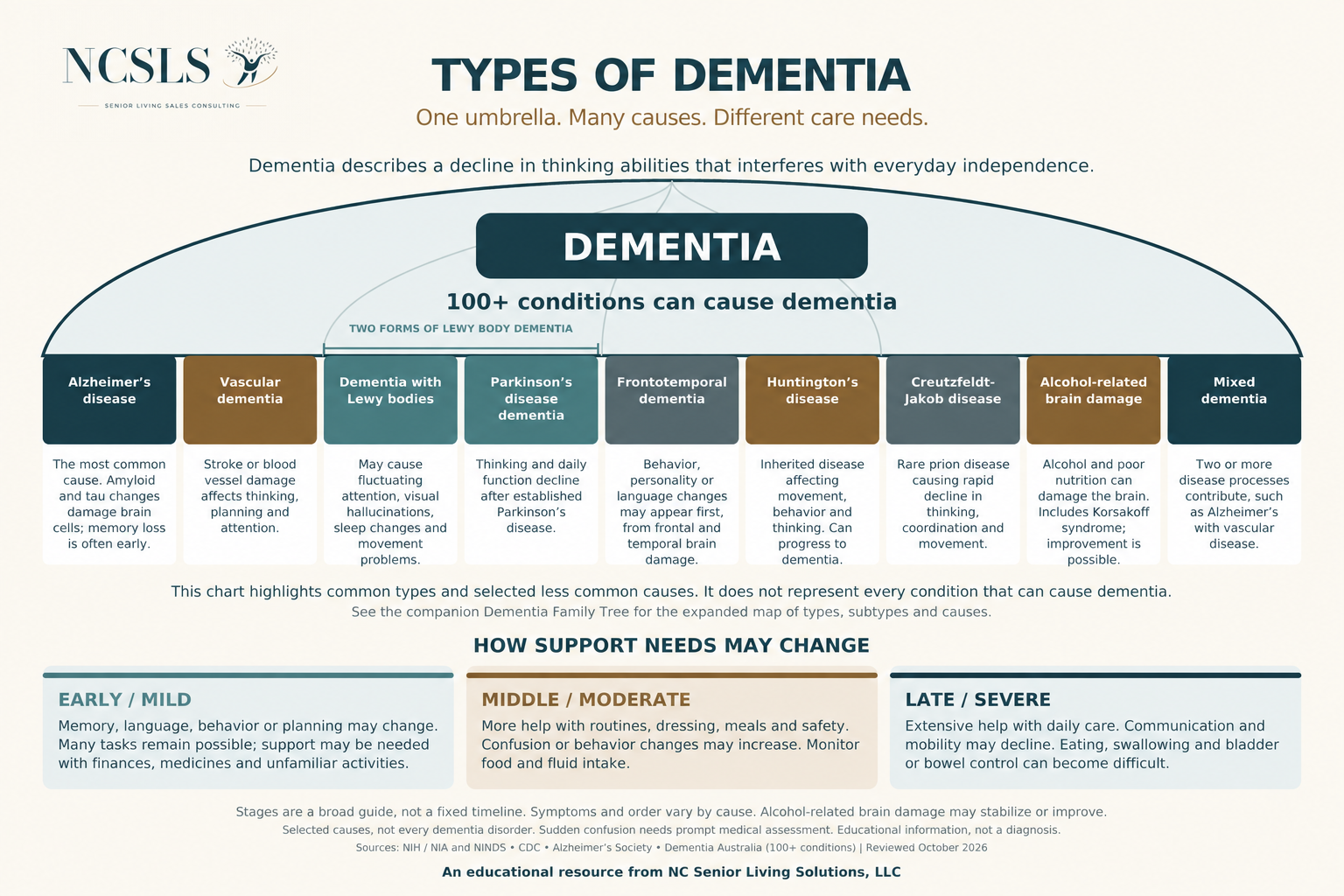
Our new visual guide offers a starting point for families, caregivers and senior living professionals. It brings common types and selected less common causes together in one easy-to-follow chart.
How many types of dementia are there?
Dementia Australia states that more than 100 conditions can cause dementia. That is why our graphic says “100+ conditions can cause dementia.” It is not an exact count of separate, unrelated types: some labels describe disease families, subtypes or overlapping conditions.
Understanding the conditions under the umbrella
- Alzheimer’s disease is the most common cause of dementia. Changes involving amyloid and tau proteins damage brain cells; memory difficulties often appear early.
- Vascular dementia results from damage related to strokes or disease of the brain’s blood vessels. Attention, planning and thinking speed may be affected.
- Dementia with Lewy bodies may involve fluctuating attention, visual hallucinations, sleep disturbances and movement changes.
- Parkinson’s disease dementia develops after established Parkinson’s disease. It belongs to the same Lewy body disease family as dementia with Lewy bodies.
- Frontotemporal dementia can begin with changes in behavior, personality or language, rather than the memory pattern many people expect.
- Huntington’s disease is an inherited disorder affecting movement, behavior and thinking. Cognitive decline can progress to dementia.
- Creutzfeldt-Jakob disease, or CJD, is a rare prion disease that usually causes rapid deterioration.
- Alcohol-related brain damage includes conditions such as Korsakoff syndrome. Heavy alcohol use and nutritional deficiencies can damage the brain. With treatment and support, some people stabilize or improve.
- Mixed dementia means more than one disease process contributes to a person’s symptoms, such as Alzheimer’s disease with vascular disease.
These categories do not cover the entire umbrella. Other causes include LATE, brain injury, certain infections, autoimmune conditions and rare inherited disorders.
Early, middle and late stages: a guide to support needs
Stage labels can help families discuss care, but they are not a fixed timetable. People do not all experience the same symptoms in the same order.
Early or mild
A person may have changes in memory, language, behavior or planning while still managing many daily activities. Finances, medicines and unfamiliar tasks may require extra support.
Middle or moderate
Help with routines, dressing, meals and safety often increases. Families may need to pay closer attention to food and fluid intake and changes in behavior or confusion.
Late or severe
A person may need extensive help with daily care. Communication and mobility can decline, and eating, swallowing or continence may become difficult. Care should respond to the person’s comfort, abilities and individual needs.
Alcohol-related brain damage deserves a separate note: it does not always follow the progressive course associated with Alzheimer’s disease. Medical treatment, nutrition and supported alcohol cessation may allow improvement.
What families should ask next
- What is the suspected cause, and what evaluation is still needed?
- Could medicines, illness, depression or another treatable condition be contributing?
- What changes should we watch for in eating, swallowing, mobility and safety?
- What support is needed today, and what would signal that the care plan needs to change?
- How does a senior living community assess changing needs and coordinate with healthcare providers?
Keep a record of specific changes and bring it to a healthcare appointment. An unusual comment, joke or disagreement alone cannot establish dementia. Sudden confusion or a rapid change from someone’s usual abilities needs prompt medical assessment.
Better understanding supports better conversations
At NC Senior Living Solutions, we believe clear information helps older adults, families and senior living professionals ask stronger questions. A diagnosis should guide an individualized conversation about care, rather than assumptions about what every person will experience.
Explore our website for senior living information and consulting services.
Sources and further reading
- National Institute on Aging: What Is Dementia?
- National Institute on Aging: Signs of Alzheimer’s Disease
- NINDS: Lewy Body Dementia
- MedlinePlus Genetics: Huntington’s Disease
- CDC: Prion Diseases
- Alzheimer’s Society: Alcohol-Related Brain Damage
- Dementia Australia: Dementia Myths and Facts
Educational information reviewed October 2026. This article does not provide a diagnosis or individualized medical advice.